
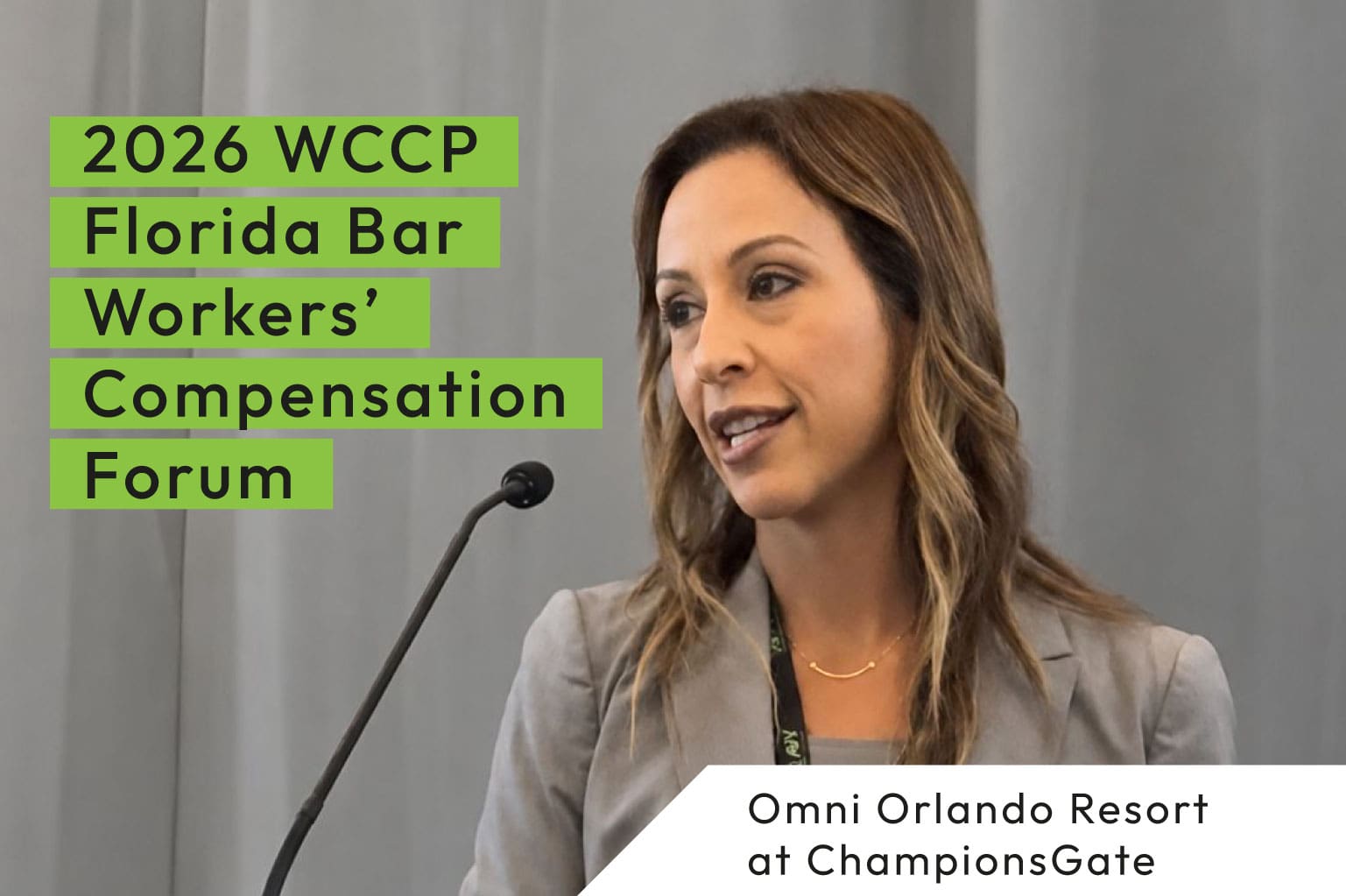
Artificial intelligence is rapidly transforming Florida workers’ compensation practice, and legal professionals must balance innovation with ethical responsibility, confidentiality, and attorney oversight. At the 2026 WCCP Florida Bar Workers’ Compensation Forum, MKRS LAW participated in critical discussions surrounding the growing role of AI in litigation strategy, legal workflows, and claims management within Florida’s workers’ compensation system.
MKRS LAW was proud to sponsor and attend the 2026 WCCP Florida Bar Workers’ Compensation Forum held April 22–24, 2026, at the Omni ChampionsGate Resort in Orlando, Florida. The annual conference brought together attorneys, judges, adjusters, employers, and insurance professionals to discuss emerging trends, legal developments, and the future of workers’ compensation practice in Florida.
Representing MKRS LAW at this year’s forum were Managing Partner Robert J. Rodriguez, Equity Partner Omar Perez, Jr., Associate Tiffany Caparas, and Partner Mariam D. Yanes.
Beyond the educational programming, MKRS LAW’s exhibit booth became a popular networking destination throughout the event, offering freshly brewed espresso to attendees between sessions and fostering conversations around litigation strategy, industry trends, and innovation in workers’ compensation defense.
What Is AI in Workers’ Compensation Practice?
Artificial intelligence is increasingly being integrated into legal operations and workers’ compensation litigation workflows. AI technologies are now being used to assist with:
- Medical record summarization
- Deposition analysis
- Litigation forecasting
- Legal drafting assistance
- Workflow automation
- Practice management
- Client communication support
For employers, insurance carriers, and claims professionals, these tools may improve operational efficiency and accelerate the handling of document-intensive claims.
However, AI also introduces significant legal, ethical, and compliance considerations that require careful oversight by attorneys.
Why AI Matters in Florida Workers’ Compensation Defense
Workers’ compensation litigation often involves large volumes of medical documentation, expert reports, depositions, and procedural filings. AI technologies have the potential to streamline portions of this process and improve case organization and internal workflow efficiency.
At the same time, Florida employers, carriers, and defense counsel must remain cautious regarding:
- Accuracy of AI-generated outputs
- Confidentiality concerns
- Ethical compliance
- Attorney supervision requirements
- Bias in automated analysis
- Reliability of predictive tools
As AI adoption increases within the legal industry, technological competence is becoming an increasingly important aspect of professional legal practice.
MKRS LAW’s Participation in the AI Technology Panel
Partner Mariam D. Yanes served as a featured speaker during one of the Forum’s most anticipated presentations:
“AI Technology in Florida Workers’ Compensation Practice”
The panel explored how artificial intelligence is reshaping modern workers’ compensation litigation and legal operations throughout Florida.
Topics discussed included:
- AI-assisted legal drafting
- Predictive analytics in litigation
- Medical record analysis
- Deposition summarization
- Workflow automation
- Ethical obligations under Florida Bar standards
- Confidentiality and data protection
- Attorney accountability and supervision
Mariam emphasized the importance of balancing innovation with professionalism, compliance, and ethical responsibility.
Common Risks Associated with AI in Legal Practice
While AI tools can improve efficiency, attorneys and organizations must remain aware of several significant risks.
Common AI Risks in Workers’ Compensation Litigation:
- Inaccurate or fabricated information (“hallucinations”)
- Incomplete legal analysis
- Confidentiality breaches
- Bias in AI-generated outputs
- Overreliance on automation
- Lack of attorney verification
- Ethical compliance concerns
Florida attorneys remain fully responsible for all work product generated or assisted by AI technologies.
How AI Is Already Being Used in Legal Workflows
AI technologies are already being implemented in several areas of legal operations and workers’ compensation defense.
Current Practical Applications Include:
- Medical Record Summarization
- AI tools can help organize and summarize large medical files for attorney review.
- Deposition Analysis
- Technology can assist in identifying key testimony, inconsistencies, and litigation themes.
- Litigation Forecasting
- Predictive systems may help evaluate claim trends and potential exposure scenarios.
- Workflow Automation
- Administrative and document-management processes can be streamlined to improve operational efficiency.
- Client Communication Support
- Automated systems may assist with scheduling, updates, and communication workflows.
Despite these advancements, attorney review and legal judgment remain essential in every stage of litigation strategy and case management.
The MKRS LAW Approach to Artificial Intelligence
While many firms are beginning to explore artificial intelligence, MKRS LAW’s approach is rooted in a simple principle: technology should enhance legal representation—not replace it.
What differentiates MKRS LAW is our commitment to combining advanced technology with decades of workers’ compensation defense experience. We utilize secure, enterprise-grade platforms such as Westlaw CoCounsel, which draw from authoritative legal sources rather than open-source or unverified internet content. This allows us to leverage AI in a manner that is both efficient and reliable while maintaining the highest standards of confidentiality and accuracy.
Our attorneys and staff are trained to understand not only what AI can do, but also where its limitations exist. Every AI-assisted task is reviewed by experienced legal professionals who apply strategic judgment, client-specific knowledge, and practical litigation experience that technology alone cannot replicate.
At MKRS LAW, we view AI as a tool—not a substitute for experience. Our clients benefit from the efficiencies of modern technology while continuing to receive the personalized attention, strategic guidance, and trusted counsel that have defined our practice since 1958.
Best Practices for Employers, Carriers, and Legal Teams Using AI
Organizations exploring AI integration within claims management and legal operations should prioritize compliance, oversight, and security.
Recommended Best Practices:
- Maintain attorney supervision over all AI-assisted work
- Protect confidential and privileged information
- Verify all AI-generated legal content
- Avoid relying solely on automated legal analysis
- Implement internal AI usage policies
- Monitor compliance with Florida Bar ethical obligations
- Evaluate technology vendors carefully
AI should support legal professionals — not replace professional legal judgment.
Why Technological Competence Matters
As technology continues to evolve, modern legal practice increasingly requires attorneys to understand both the capabilities and limitations of AI tools.
The 2026 WCCP Forum highlighted the growing importance of technological competence within Florida workers’ compensation practice, particularly as employers, carriers, and law firms adopt more advanced systems for claims handling and litigation management.
MKRS LAW remains committed to staying at the forefront of legal innovation while maintaining the professionalism, strategic guidance, and ethical standards our clients expect.
Frequently Asked Questions
Can AI replace workers’ compensation attorneys?
No. AI may assist with workflow efficiency and document analysis, but attorneys remain fully responsible for legal strategy, compliance, and case outcomes.
What are the biggest risks of AI in legal practice?
Common risks include inaccurate outputs, confidentiality concerns, bias, ethical violations, and overreliance on automated systems.
How is AI currently used in workers’ compensation defense?
AI is being used for medical record summarization, deposition review, litigation forecasting, workflow management, and administrative automation.
Are attorneys responsible for AI-generated work product?
Yes. Attorneys remain fully accountable for all filings, legal analysis, and work product generated with AI assistance.
Why is technological competence important for attorneys?
Modern legal practice increasingly requires attorneys to understand emerging technologies, ethical obligations, and the limitations of AI systems.
Conclusion
The legal industry is entering a new era where artificial intelligence and legal strategy increasingly intersect. For employers, carriers, and workers’ compensation professionals, understanding both the opportunities and risks associated with AI is becoming essential.
By actively participating in industry conversations surrounding AI, compliance, and litigation innovation, MKRS LAW continues to position itself at the forefront of Florida workers’ compensation defense.
Our attorneys remain committed to combining decades of litigation experience with a forward-thinking approach to technology, risk management, and client service.
Contact MKRS LAW
If your organization is seeking experienced workers’ compensation defense counsel with a strategic and technology-conscious approach to litigation, compliance, and claims management, contact MKRS LAW today.
Our team proudly represents employers, insurance carriers, municipalities, and businesses throughout Florida in complex workers’ compensation and insurance defense matters.